Between July and September 1945 the long war came to its end in the mountains of the north. In the high Cordillera the guerrilla army ground down the last of Yamashita's Shobu Group ridge by ridge — Kolos Hill, the Lepanto Mines, Mankayan, Mayaoyao, Bontoc — while the enemy died of American guns and Filipino ambush and the hunger and cold of the heights. Then, far away, two cities were destroyed by a single bomb apiece, and on the fifteenth of August the emperor surrendered. Volckmann gave the order to cease firing along the Ifugao-Benguet line. On the second of September the Tiger came down at last out of the Asin valley at Kiangan, and on the third he signed the surrender of all his forces at Camp John Hay in Baguio, with a Filipino guerrilla commander at the table. The occupation was over. The red lifted from the map, and the islands were whole again. This is how those three months were lived, here, on the islands.
1 July 1945
BattleKolos Hill, Benguet
The last mountains were the hardest. On Kolos Hill the 66th Infantry climbed into the enemy's guns through July, taking their dead and giving worse — one Japanese charge broken at close range left eighty enemy bodies on the slope. On a hill in Benguet the guerrilla army bled to break the final defenses of Yamashita's redoubt. There was nothing easy left in the war, and no shortcut to its end.
Benguet →USAFIP-NL 66th Infantry battle for Kolos Hill, Benguet, early July 1945 (supplied).
9 July 1945
BattleThe Lepanto Mines, Benguet
After days of assault the 66th Infantry stormed the Japanese command post above the mines and killed its commander, Colonel Furumi, with fifteen of his officers; and on the ninth, after a two-hour barrage, the enemy abandoned the Lepanto Mines altogether. The great copper works the empire had bled the mountains for now fell to the men of the mountains. Mine by mine, ridge by ridge, the north was taking back its own.
Benguet →USAFIP-NL 66th Infantry captures the Lepanto Mines and kills Col. Furumi, 7–9 July 1945 (supplied).
10 July 1945
BattleBontoc, Mountain Province
In the Mountain Province the 121st Infantry fought its way into Bontoc town and took it. The Igorot highlands that had sheltered the resistance and hidden the fleeing — that had dug Judy Geronimo out of her grave — now saw the enemy driven from their heart. The guerrilla army was closing on Yamashita from every ridge at once.
Mountain Province →USAFIP-NL 121st Infantry captures Bontoc town, 10 July 1945 (supplied).
12 July 1945
StoryToward Mayaoyao, Ifugao
Blackburn led a provisional regiment out of Solana and Enrile into the high Ifugao country, on a grueling mountain march to run down the Japanese generals holding out at Mayaoyao. It was war at the top of the islands, among the rice terraces the ancestors had carved into the sky — the guerrillas climbing to the last places the enemy could hide.
Ifugao →USAFIP-NL provisional regiment under Blackburn marches for Mayaoyao, Ifugao, from 12 July 1945 (supplied).
15 July 1945
StoryThe Cordillera
Sealed in the mountains, the Shobu Group was dying even where no one fought it. Cut off from food and medicine, the enemy's tens of thousands starved on the ridges, sickened in the cold and the rain, and ate what the terraces and the forest gave before they ate nothing at all. Yamashita's army was being killed as much by the mountains as by the guns. The end would be a slow one, and a hungry one.
Ifugao →Starvation and attrition of the Shobu Group in the Cordillera, mid-1945.
28 July 1945
BattleThe Ifugao-Benguet boundary
On the twenty-eighth Volckmann threw his whole army into the last blow — the 15th, the 66th, and the 121st together, with the air force and the guns behind them — driving straight at Yamashita's Shobu Group along the Ifugao-Benguet line. The hidden soldiers of three years had become a corps that could mount a general offensive in the high mountains. They meant to finish it.
Ifugao →USAFIP-NL general offensive against the Shobu Group, 28 July 1945 (supplied).
30 July 1945
StoryThe Cordillera
The monsoon fought on the enemy's side to the end. The rains washed out the mountain trails and cut the guerrillas off from their supplies, until the transport planes had to free-drop food and shells over Bontoc through the cloud — some of it drifting down, by cruel chance, into the enemy's lines. The land and the sky ruled the last battle as they had ruled the first. Nature kept its own calendar over the war's close.
Mountain Province →Monsoon disruption and air-drop resupply in the Cordillera campaign, July 1945 (supplied).
6 August 1945
StoryThe world beyond the islands
Word came of a thing beyond understanding: a single bomb had destroyed a whole Japanese city, Hiroshima, and three days later another had destroyed Nagasaki. The islands, which had seen their own capital burned street by street, could scarcely grasp a fire that could kill a city in a flash. But they understood what it meant. The war that had ground on for four years was about to end, all at once.
News of the atomic bombings of Hiroshima (6 Aug) and Nagasaki (9 Aug 1945).
9 August 1945
BattleMayaoyao, Ifugao
High in Ifugao the 11th Infantry swept into Mayaoyao and scattered the enemy, taking back even the supplies the rains had dropped by mistake into Japanese hands. The last organized battle of the guerrilla army was won among the rice terraces at the roof of the islands. From here there was nowhere higher for the enemy to run.
Ifugao →Battle of Mayaoyao; USAFIP-NL 11th Infantry victory, 9 Aug 1945 (supplied).
10 August 1945
StoryBanaue, Ifugao
His mountain breakout complete, Blackburn brought his guerrillas down to Banaue and joined hands with the conventional American divisions coming up from below. The hidden army and the regular army met at last in the high terraces, two halves of one force closing the ring on Yamashita. The circle around the Tiger's redoubt was all but shut.
Ifugao →Blackburn's regiment links with US conventional forces at Banaue, 10 Aug 1945 (supplied).
13 August 1945
StoryBontoc and the Cordillera
As the sub-province of Bontoc was cleared and the pockets closed, the last of the hidden came out — the prisoners and the hostages the enemy had dragged into the mountains, the hostages of his final cruelty, the survivors of villages he had burned on his way up. Some the guerrillas freed in time; some they found too late. The war spent its last cruelty on the high country, and the high country remembered.
Mountain Province →Clearing of Bontoc and the freeing of the last prisoners and hostages, mid-Aug 1945 (supplied).
15 August 1945
StoryThe Ifugao-Benguet line
On the fifteenth the word came down out of the sky: the emperor had surrendered. Volckmann sent his order to every regiment still locked with the enemy along the Ifugao-Benguet line — cease firing. On the ridges the guns went quiet, and men who had been trying to kill each other an hour before stood in the sudden silence and understood, slowly, that it was over. The longest fight of their lives had ended between one breath and the next.
Ifugao →Japan's surrender; Volckmann's cease-fire order to USAFIP-NL, 15 Aug 1945 (supplied).
15 August 1945
StoryAcross the islands
When the word reached the towns and the barrios the islands wept and shouted and knelt in the churches all at once. Four years — of hunger and fear, of the Kempeitai and the zona, of the dead uncounted — were over. In the ruins of Manila and the freed provinces the people poured into the streets, and the bells that still had towers to hang in rang out over a country that had, against everything, survived. The war was over. They had lived to see it.
V-J Day reactions across the liberated Philippines, 15 Aug 1945.
25 August 1945
StoryIfugao
From his mountain redoubt Yamashita sent word to the Americans in Ifugao: he had ordered all his forces across the islands to lay down their arms. The Tiger of Malaya, who had held the mountains longer and harder than anyone thought possible, bowed at last to the emperor's word. The soldier who meant to die in the Cordillera would come down instead to surrender.
Ifugao →Yamashita's order for all Japanese forces in the Philippines to surrender, 25 Aug 1945 (supplied).
2 September 1945
StoryThe Asin valley, Kiangan, Ifugao
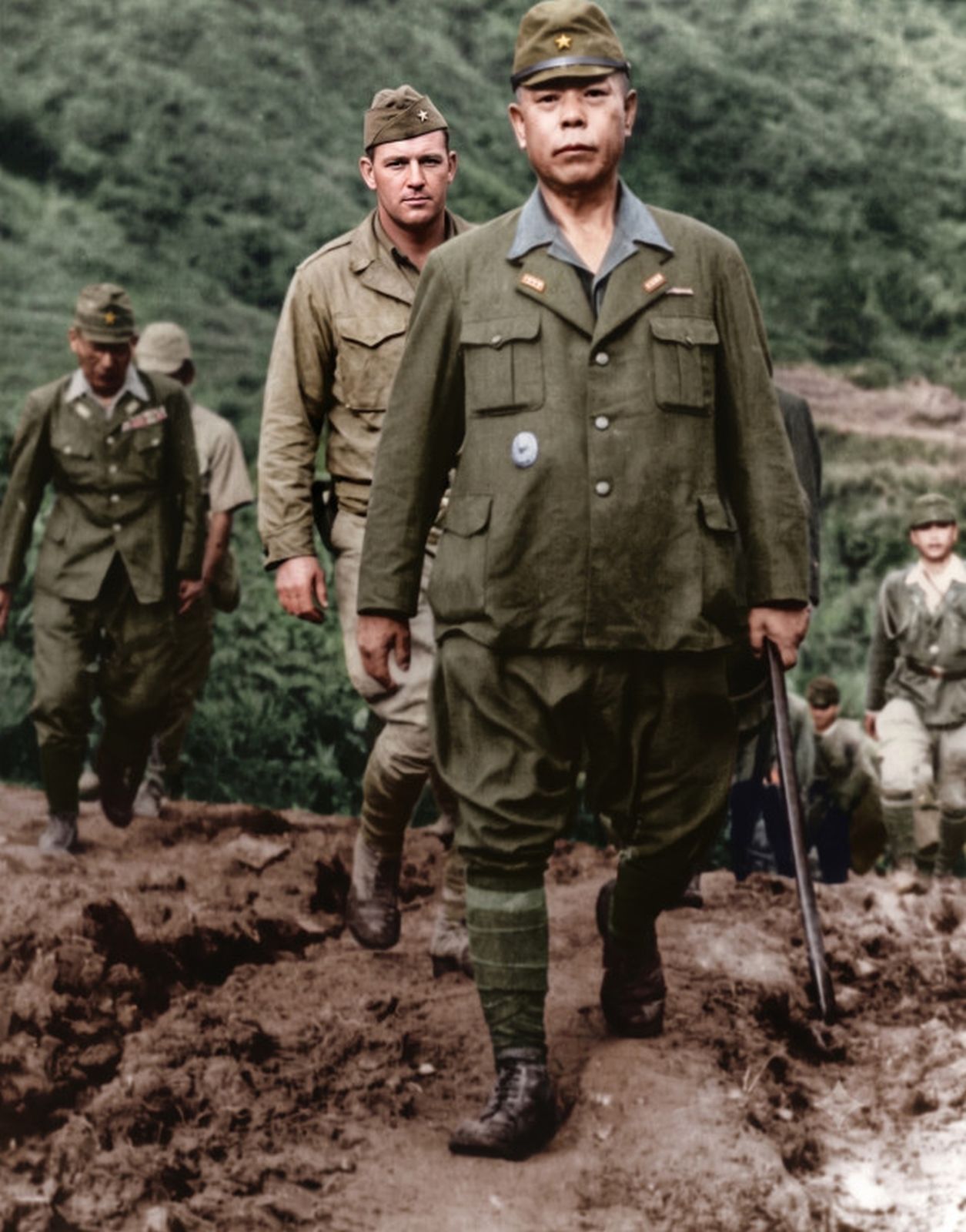
General Tomoyuki Yamashita comes down from the mountains at Kiangan to surrender, 2 September 1945. U.S. Army Signal Corps (colorized)
On the second of September, the same day the great surrender was signed in Tokyo Bay, Yamashita walked down out of the Asin valley at Kiangan with twelve of his staff officers and gave himself up to the American and Filipino forces. He had held the last redoubt with tens of thousands of men to the very end. Now he came down through the rice terraces of Ifugao — the same terraces that had sheltered the guerrillas — to answer for the war. They carried him out through Luna and up to Baguio.
Ifugao →Yamashita's surrender at Kiangan, Ifugao, 2 Sep 1945 (supplied).
3 September 1945
StoryCamp John Hay, Baguio
On the third of September, at Camp John Hay in Baguio, Yamashita signed the surrender of all Japanese and Japanese-controlled forces in the Philippines. And there at the table, among the American generals, sat Colonel Volckmann of the USAFIP-NL — the man who had built an army out of the stragglers and the barrio boys and led it through three years of hiding and two of open war — representing the Filipino guerrillas. The hidden army of the islands received the surrender of the enemy it had never stopped fighting. It was V-J Day. The occupation was over.
Benguet →Formal Japanese surrender at Camp John Hay, Baguio; Volckmann represents the guerrillas, 3 Sep 1945 (supplied).
3 September 1945
StoryThe archipelago
So it ended, where it had begun, in the islands. From Batanes to Tawi-Tawi the flag flew free, and the people who had carried the promise on a matchbox through the darkest years stood in the light of a country that was their own again. They had paid more than any words could hold — but they had endured, and resisted, and won back their home. The long night was over, and the morning, hard and bright, had come.
V-J Day and the end of the Japanese occupation of the Philippines, Sep 1945.
8 September 1945
StoryMindanao and the islands
Across the islands the beaten enemy came in to surrender — down from the Cordillera, out of the Mindanao jungle where more than twenty thousand had held on, off the far small islands where a few had waited unknowing. The great army that had swept ashore in triumph in 1941 gave itself up in rags and hunger in 1945. The occupation ended not with a battle but with a long, thin file of the defeated coming down out of the hills.
Davao del Sur →Mass surrender of scattered Japanese forces across the Philippines, Sep 1945.
15 September 1945
StoryManila
With the peace came the accounting. Laurel and his ministers were brought back from Japan to face the courts; the Makapili and the informers were hunted and tried; and the long, bitter argument began over who had collaborated, and why, and what it had been to survive under the enemy. There were no easy answers, and the wounds ran deep. The war against Japan was over. The Filipino reckoning with the occupation would take a generation.
The collaboration reckoning and the return of the Laurel government to face trial, 1945.
20 September 1945
StoryThe islands
When the counting was done, the price stood plain and terrible. More than a million Filipinos were dead — the massacred of Manila and Panay and a hundred barrios, the starved of the long famine, the fallen of Bataan and the camps and the hills, the numberless who simply did not come home. Whole families were gone, whole towns unmade, the capital a graveyard. Freedom had been bought at the highest price the islands ever paid. It would not be forgotten.
The human cost of the war in the Philippines (~1 million Filipino dead), 1945.
25 September 1945
StoryThe archipelago
On the map of the islands the last red lifted away, and the archipelago showed whole again from Luzon to the Sulu sea — no province held, no dot dark, the country its own from end to end. The burned fields would grow back; the ruined cities would rise; the terraces the war had fought across would feed the mountains once more. The land had outlasted the occupation, as it had outlasted every conqueror before. It was whole, and it was free, and it began again.
The complete liberation of the Philippines; the archipelago restored, Sep 1945.
30 September 1945
StoryThe islands
So closes the record of those four years — told, as far as it could be, only as the islands themselves could know it. It was a time of terror and hunger and loss beyond counting; but it was also the time the Filipino found, in the hardest test, what he was and what he loved. The stragglers who would not surrender, the fishermen who caught an empire's secret from the sea, the woman dug alive from her grave, the boys who took a mountain fortress in the sun — they are the pinanggalingan, the place we came from. We keep their story so that those who travel the seven thousand islands today may glance back at it, and carry it forward, and love the country it was paid for. Ito ang ating pinanggalingan. This is where we came from.
Closing reflection — Sulyap sa Pinanggalingan, the meaning and memory of the occupation years.